2000 words: 10 minute read. Click images to enlarge
The use of the legally designated land in Tournerbury Woods is governed by nature conservation and planning legislation that protects the rarest and most valuable landscapes from harmful development. Under the Wildlife and Countryside Act 1981, Natural England manages protected landscapes including the Chichester Harbour Site of Special Scientific Interest (SSSI) where the woods are located, and it required the owners to follow the terms of a protective management plan for nature conservation in Tournerbury Woods in 1997.
In an unprecedented situation that Natural England has said reflects its own failures of documentation management for the site, there are two different versions of the management plan (called Site Management Statements or SMS):
- the Natural England version from 1997
- the version supplied by the owners in 2013
These management plans are identical except that the version supplied by the owners in 2013 has one extra line and the map carries an additional annotation. This extra line and the map annotation define the area now used as an event venue as a ‘Business amenity area’ (this is not defined in legislation), where it says ‘consent is not required for operations’. In this context ‘operations’ means ‘Operations Requiring Natural England’s Consent’ (ORNECs), which is a list of 28 actions that would harm the special interest of the SSSI if they were taken including infilling watercourses, construction of tracks, destruction of plants (including trees) and construction of buildings.
Saving Tournerbury Woods asked the Office for Environment Protection (OEP) to rule on which management plan was valid, and they said ‘there was insufficient evidence to say conclusively which version of the SMS was the original to be modified’. Natural England wrote to the owners in 2014 accepting that they ‘would work with this one going forward’ referring to the owners version.
In practice, this means that Natural England do not object to development that would breach the rules anywhere else in the Chichester Harbour SSSI, as it cannot object to this in the venue area at Tournerbury. The version of the management plan supplied by the owners suspends the SSSI rules in the ‘Business Amenity Area’, although Natural England says that it has not, and will not, remove SSSI status at this location.
This means that other legal provisions relating to SSSIs still apply, such as the status in local plans and we believe the Council should protect it not develop it. There are also some provisions in the management plan that apply everywhere in the woods such as rules on the retention of dead wood in situ and a ban on upgrading earth tracks.
However, any change of use from agricultural or construction work in Tournerbury Woods is covered by the requirement to obtain planning consent under the Town & Country Planning Act 1990 from the Council. Havant Council has policies that require it to respect nature protection designations when considering planning decisions:
- Strategic Policy CS11 Protecting and Enhancing the Special Environment and Heritage of Havant Borough
- Strategic Policy CS12 Chichester Harbour Area of Outstanding Natural Beauty (AONB) (now called a National Landscape)
- Strategic Policy CS15 Flood and Coastal Erosion Risk
- Development Management Policy DM8 Conservation, Protection and Enhancement of Existing Natural Features
- Development Management Policy DM9 Development in the Coastal Zone
This Havant Council map confirms that these policies apply to Tournerbury Woods. These protections for a SSSI are considered important nationally, and breaching them would set a significant precedent across the country. No new permanent buildings are known to have been authorised for construction actually within the boundary of an SSSI anywhere in England for non-defence uses since the Wildlife and Countryside Act 1981 was brought into force. Tournerbury Woods must not be the first!
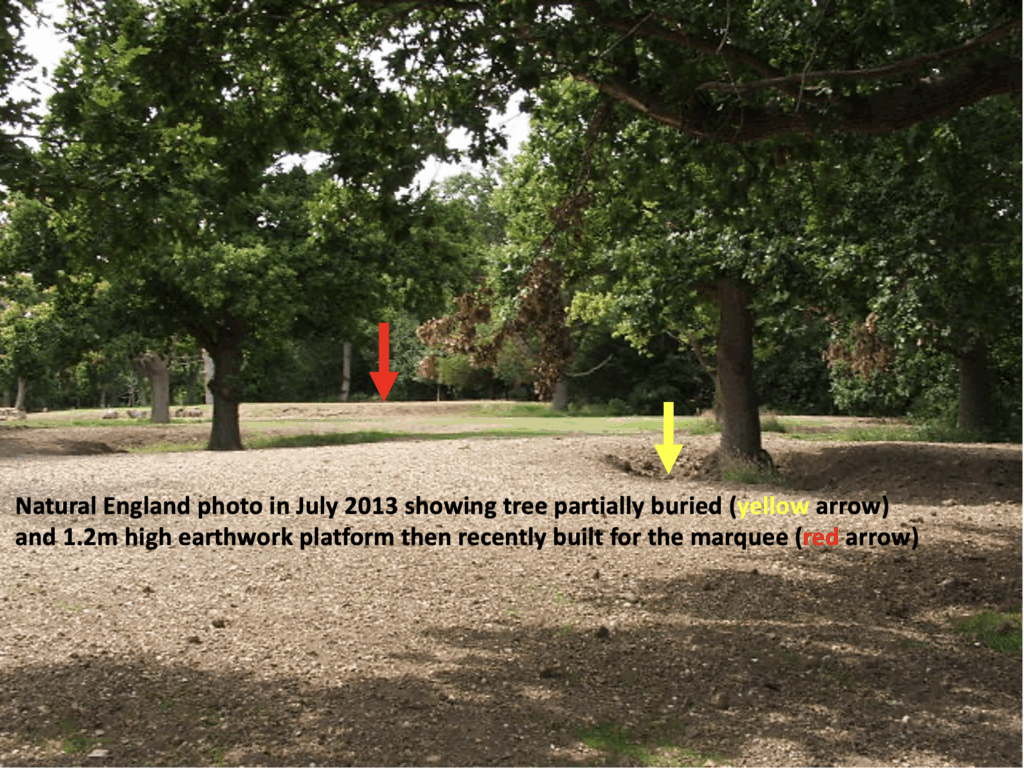
However, despite these protections, neighbours to Tournerbury Woods could see that a semi-permanent marquee had been erected on a large earthwork platform constructed in the woods without planning consent in early 2013, and a publicly advertised event venue has been operating at the site since that time. The woods are not on a public road but they have a private right of way for all purposes through the yard of Tournerbury Farm. This single lane gravel track should only be used for agricultural purposes at the moment without a planning consent for a change to commercial use status, but it is nonetheless currently used for venue access.
The owners of the woods applied to the Council for retrospective planning consent for access and building at the venue in 2018 (APP/18/00943), though the earthwork platform was not mentioned. However, the application was refused on the grounds of noise and lighting disturbance and poor access through the farmyard. The owners also submitted an application for a Certificate of Lawfulness in 2019 (APP/19/01262) for the buildings already erected including the marquee (with permanent foundations since 2016), an open sided wooden Deck building, and a gazebo, but this application was also refused for the same reasons.
From 2013 the venue has conducted its operations without planning consent by depending on Class B agricultural permitted development rights for the venue buildings and use. However, all structures and access tracks constructed under temporary permitted development rights must be removed after 28 days each year and they have not been removed at this site since 2016 (see Country Landowners Association guidance).
Government guidance (ODPM Biodiversity and Geological Conservation Circular 06-2005) cited in National Planning Policy Framework (NPPF) 2024 on p55 as ‘statutory guidance’, clearly states in para 75 that Permitted Development rights are withdrawn from land within SSSIs without authorisation from Natural England, which has not been explicitly given. We do not accept that the management plan (SMS) gives this authorisation as permitted development is not mentioned anywhere within it. This was also the view of a Legal Opinion (p9) prepared for the Chichester Harbour Conservancy in 2019.
The Council took action against the owners of the site in 2020 by serving an Enforcement Notice (APP/21/00006) requiring the removal of buildings and the cessation of events. The owners appealed against this decision but withdrew their appeal in May 2022 when the Council changed their position and agreed a Non-Prosecution Agreement with the owners.
This Non-Prosecution Agreement committed the Council not to enforce the lack of planning consent while the owners were given time to make a second similar retrospective planning application (APP/21/01310) for the same venue and access route but a reduced number of events. The Planning Committee considered, but then deferred, a decision on APP/21/01310 in December 2022 and have not yet made a decision on it, despite a decision being required within 6 months under the Town & Country Planning Act 1990.
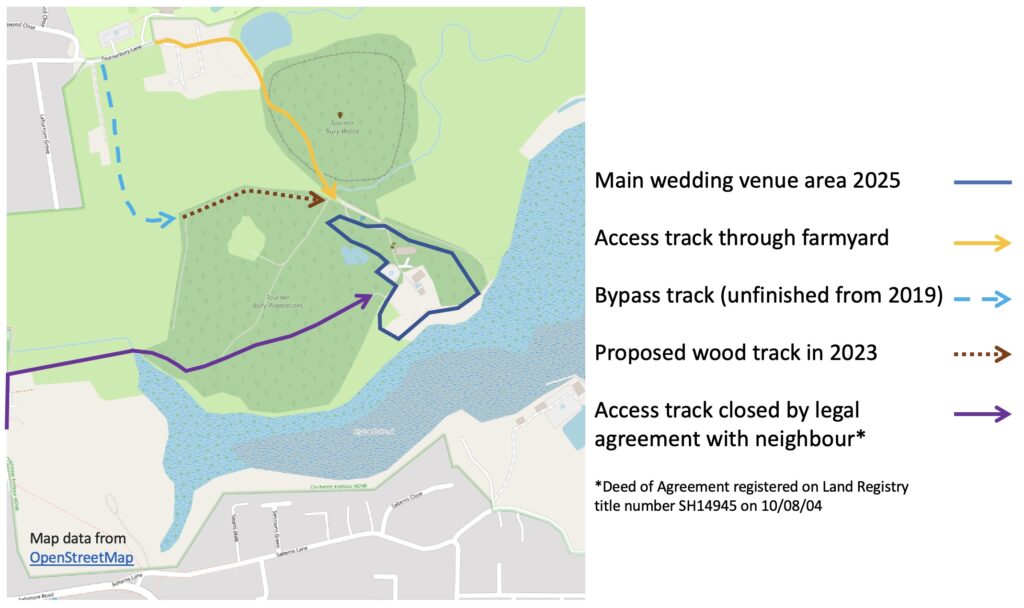
The owners then submitted a third similar retrospective planning application (APP/23/00076) in 2023, which sought approval for access to the same venue via an alternative track bypassing the farmyard. This application was granted approval by the Council Planning Committee in August 2023 on the condition that venue traffic used the bypass track and that the owners secured the right to use it across the neighbouring Tournerbury Farm.
This right of access has subsequently been denied, and the bypass track still has a gap where it would need to cross a channel carrying drainage along the western boundary of the woods. From 2023 to the present while this consent could not be implemented, the venue has continued operation under the Non-Prosecution Agreement using the all-purpose private right of way through Tournerbury Farm, which, though, has no planning consent for commercial use. We believe that if the owners wish to seek a planning consent that is completely unusable without access, they should have to obtain consent for access first and not waste public money on an application that cannot be implemented.
Saving Tournerbury Woods took action in 2023 to protect the woods from development that we believed did not comply with the legal designations in place. In particular we highlighted the failure of the Council to properly consider Chichester Harbour Conservancy’s (CHC) management plan when it made its recommendation to councillors to approve APP/23/00076. This plan has been formally adopted by Havant Council through the Joint Supplementary Planning Document for Chichester Harbour AONB (JSPD) (now National Landscape).
The High Court agreed with our challenge to the Council’s decision to approve APP/23/00076 and gave Saving Tournerbury Woods permission to challenge it in May 2024 by Judicial Review in case AC-2023-LON-00319. The Council withdrew its objections in October 2024, accepted that it had behaved unlawfully, paid our costs and consented to the overturning of the decision. The decision to revoke the planning consent for APP/23/00076 was formalised by the High Court in March 2025.
Since the Judicial Review case was heard in the High Court in 2024, Section 85 of the Countryside and Rights of Way Act 2000 has been amended to create a duty for local authorities ‘to further the purpose of conserving and enhancing the natural beauty of the National Landscape’ as set out in Government Guidance on this Section 85 Duty.
The special qualities making up the natural beauty of the CHC National Landscape are protected from inappropriate development through the seven Planning Principles. Development in Tournerbury Woods would affect:
- Landscape setting, especially the positioning of light coloured buildings such as a white marquee within the wooded shoreline (Planning Principle 1 and para 16.1 of the JSPD)
- Tree cover and birdlife as trees have been affected by earthworks constructed at the site without planning consent (Planning Principle 1 and para 9.1 of the JSPD)
- Dark skies without artificial light, as venue lights are permanently lit and headlights of car passing under the Heronry and over the Bury Ancient Monument cause disturbance to birds (Planning Principle 5 and para 30.1 of the JSPD)
The CHC Management Plan says in Planning Principle 4 that ‘New tourism, commercial or agricultural development will be supported where it is demonstrated there will be no harm from visual intrusion, noise, increased activity nor erosion of rural character. Development of an event venue in Tournerbury Woods generates all of these harms in this Planning Principle.
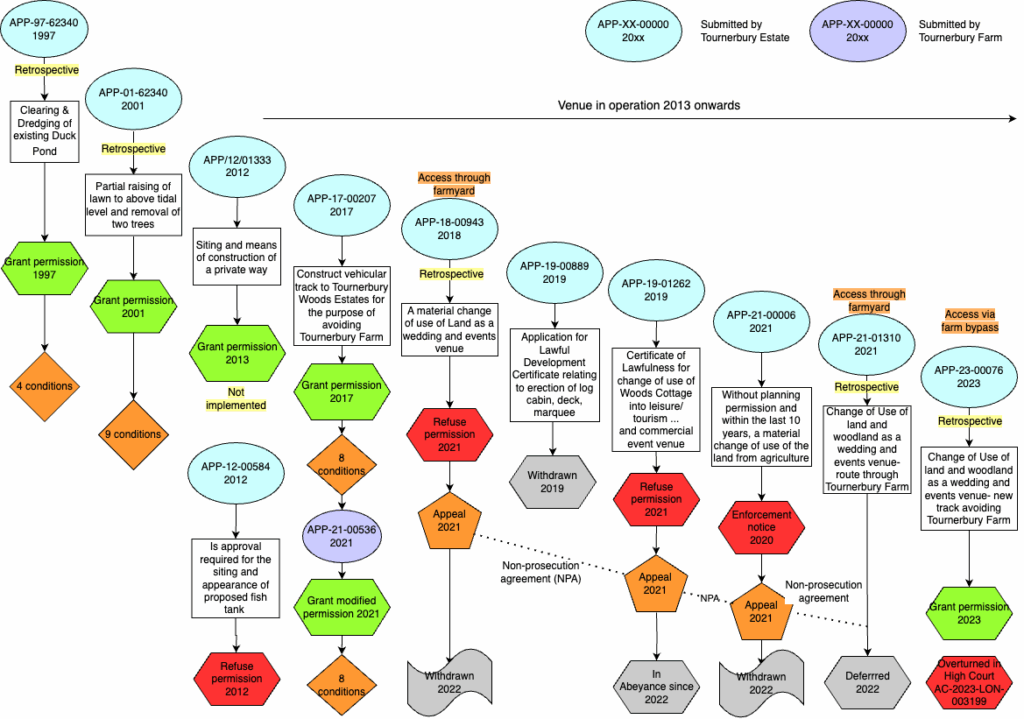
In total, the owners have submitted five planning applications or Certificates of Lawfulness applications since 2018 seeking retrospective approval for the construction and venue operations since 2013 in these highly protected woods (see diagram below). One of these was withdrawn (APP/19/00889), two were refused (APP/18/00943 & APP/19/01262), one was overturned (APP/23/00076) and one was deferred (APP/21/01310). Given appeals and legal action, three (1262, 130 and 76) are still to be decided.
The construction of the bypass track over farmland to the edge of the woods in APP/17/00207 was given planning consent in 2017 and an updated consent in 2021. These consents are for construction only and not for use to access the venue, but this track was not fully completed when built in 2019.
Saving Tournerbury Woods met with the CEO of Havant Council in April 2025 to request that the Council used a Stop Notice to prevent the events continuing until or unless planning consent had been obtained. We believe that to allow discretion to operate under the current circumstances clearly fails the public interest test of non-enforcement under para 13 of the government’s Planning Enforcement Guidance.
However, the terms of the Non-Prosecution Agreement bind the Council to maintain the protection of the site from enforcement until a planning application is decided, and the Non-Prosecution Agreement has in effect bypassed the planning system for over 3 years without any formal end date, and could continue to do so for even longer so long as the Council do not decide at least one planning application. Note also that the Non-Prosecution Agreement gives the owners one more year after all applications and any appeals are settled before the protection from planning law expires.
If you have read down to the bottom of this page, you can see how complex this matter has become. This situation has arisen because the council has allowed multiple applications to be made without determination, it has served an Enforcement notice but not stopped operations at the venue, and it has facilitated ongoing operations through the Non-prosecution Agreement when there is no planning consent. In a legal phrase, this has ‘fettered the councils discretion’. It is now very difficult for the council to do the simple thing which is to stop all activity, unless and until, a planning consent in place.
Planning application APP/23/00076 has now been put out for consultation until December 24th 2025 and will be considered by the Havant Planning Committee in early 2026. We urge all those with a local interest in preserving the woods or a national interest in protecting SSSIs to comment on the Havant Planning portal and object to this development by searching for ‘APP/23/00076’ and submitting a short objection to the proposal.
December 2025 update